
Neck pain that travels into the shoulder, arm, or hand may occur when a nerve root in the cervical spine becomes irritated or inflamed. Patients may experience shooting or burning pain, numbness, tingling, or other nerve-related symptoms that interfere with work, sleep, exercise, and everyday activities.
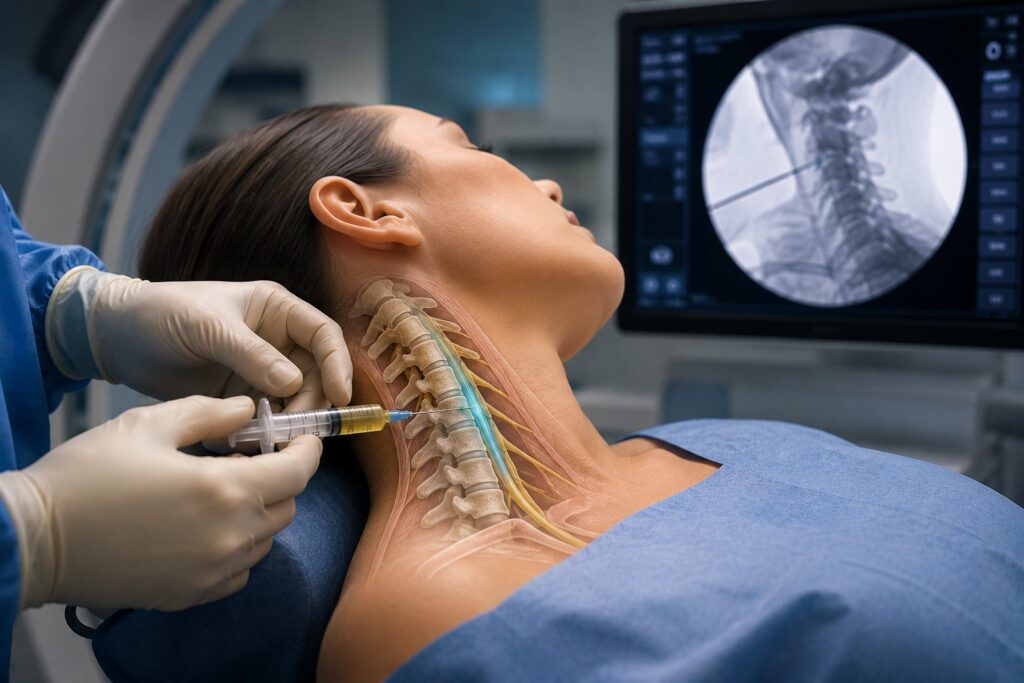
When these symptoms persist despite appropriate conservative treatment, a cervical epidural steroid injection (ESI)may be considered.
A cervical epidural steroid injection is a minimally invasive procedure that delivers anti-inflammatory medication into the epidural space surrounding spinal nerves in the neck. It is commonly used for cervical radiculopathy associated with conditions such as a cervical disc herniation or certain forms of cervical spinal stenosis.
At TOPS Institute, we provide image-guided cervical epidural steroid injections in Los Angeles and Beverly Hills as part of a diagnosis-driven approach to neck and nerve pain.
The cervical spine consists of seven vertebrae. Nerve roots exit the cervical spine and travel toward the shoulders, arms, and hands.
If one of these nerve roots becomes irritated or inflamed, patients may develop cervical radiculopathy, commonly described as a pinched nerve in the neck.
A cervical epidural steroid injection is designed to deliver medication to the epidural space near the affected nerves.
The goal is to reduce inflammation and relieve nerve-related symptoms.
The injection does not physically remove a herniated disc, reverse arthritis, or widen a narrowed spinal canal. Instead, it targets inflammation associated with an irritated cervical nerve.
Cervical epidural steroid injections are primarily used to address radicular pain caused by irritation or inflammation of a cervical nerve root.
Depending on the patient’s diagnosis, an injection may be considered for:
Symptoms may include pain extending from the neck into the shoulder, arm, hand, or fingers.
Some patients may also experience numbness or tingling.
A comprehensive evaluation is necessary to determine whether the patient’s symptoms are nerve-related and whether an epidural steroid injection is an appropriate treatment.
Cervical radiculopathy develops when a cervical spinal nerve root becomes irritated or compressed.
Patients may experience:
A cervical epidural steroid injection may be considered when inflammation surrounding the affected nerve contributes to persistent symptoms.
The injection is intended to reduce inflammation around the nerve rather than directly eliminate the structural condition causing nerve irritation.
A cervical disc herniation occurs when material from one of the spinal discs in the neck extends beyond its normal boundary.
If the displaced disc material irritates or compresses a nearby nerve root, the patient may develop cervical radiculopathy.
A cervical epidural steroid injection does not repair or remove the herniated disc.
Instead, corticosteroid medication may help reduce inflammation around the affected nerve root and relieve associated radicular symptoms.
Cervical spinal stenosis refers to narrowing within portions of the cervical spine.
When narrowing affects an individual nerve root, patients may develop radiating arm pain, numbness, tingling, or other symptoms of cervical radiculopathy.
For appropriately selected patients, a cervical epidural steroid injection may be considered to address inflammation around the affected nerve.
However, an epidural injection does not widen the spinal canal or treat spinal cord compression.
Patients with significant spinal cord compression, cervical myelopathy, progressive weakness, balance problems, or loss of hand coordination may require additional specialist or surgical evaluation rather than treatment directed solely toward pain.
Corticosteroid medication is used for its anti-inflammatory effect.
When a cervical nerve root becomes irritated, inflammation can contribute to pain and neurological symptoms.
Delivering medication into the epidural space may help decrease inflammation around the affected nerve and reduce symptoms such as:
A local anesthetic may also be used depending on the procedure and individual clinical circumstances.
The degree and duration of improvement vary between patients.
Cervical epidural steroid injections are typically performed as outpatient procedures.
Because of the anatomy surrounding the cervical spinal cord and nerves, precise image guidance is an important component of the procedure.
The procedure generally involves:
The specific technique depends on the patient’s anatomy, symptoms, imaging findings, and treatment goals.
There are different approaches to delivering medication into the cervical epidural space.
A cervical interlaminar epidural steroid injection accesses the epidural space through an interlaminar approach.
Medication is delivered into the epidural space and can spread toward irritated cervical nerve roots.
A cervical transforaminal epidural steroid injection is a more targeted approach in which medication is delivered near a specific cervical nerve root through the neural foramen.
The appropriate approach depends on the patient’s anatomy, diagnosis, imaging, potential benefits, and procedural risks.
Both procedures deliver medication near cervical spinal nerves, but the approach differs.
A cervical interlaminar epidural injection accesses the broader epidural space.
A cervical transforaminal epidural injection targets the region around a particular cervical nerve root.
One approach is not automatically appropriate for every patient.
Selection depends on:
TOPS Institute evaluates these factors before recommending a specific injection technique.
A cervical epidural steroid injection may be considered for selected patients with persistent cervical nerve-related pain.
Potential candidates may include patients who:
An epidural steroid injection is not necessarily appropriate for isolated muscular neck pain or every type of chronic neck pain.
The underlying diagnosis matters.
Cervical epidural steroid injections are primarily directed toward nerve-related pain and inflammation.
Other treatments may be more appropriate when neck pain originates primarily from another structure.
For example:
Facet-mediated neck pain may be evaluated with cervical medial branch blocks and potentially treated with cervical radiofrequency ablation when appropriately diagnosed.
Myofascial neck pain may respond to rehabilitation or trigger point treatment when painful muscle trigger points are identified.
This is why identifying the pain generator before selecting an injection is important.
The duration of relief varies considerably.
Some patients experience meaningful improvement for weeks or months, while others have shorter or limited relief.
Results depend on factors including:
A cervical epidural steroid injection is generally used as part of a broader treatment plan rather than viewed as a permanent cure for the underlying spinal condition.
The response varies.
Some patients may notice improvement relatively soon after the injection, while the corticosteroid’s anti-inflammatory effect may take several days to become more noticeable.
Temporary soreness or a temporary increase in discomfort may occur after the procedure.
Patients receive specific post-procedure instructions and should contact their healthcare provider regarding unexpected or concerning symptoms.
There is no single number that is appropriate for every patient.
The frequency of cervical epidural steroid injections depends on factors such as:
Injections should not simply be repeated automatically.
The decision to perform another injection should be based on the patient’s response and current clinical condition.
Cervical epidural injections are commonly performed but require careful technique because of the important neurological and vascular structures within the neck.
Potential risks and side effects can include:
Certain medical conditions and medications, including blood-thinning medications, may affect procedural planning.
The potential benefits and risks should be reviewed individually before treatment
Cervical epidural steroid injections are generally outpatient procedures.
Patients are monitored after the injection and receive instructions regarding activity and recovery.
Temporary soreness may occur around the injection area.
Depending on the patient’s condition and response, treatment may be combined with physical therapy, exercise, ergonomic changes, or other strategies designed to improve function.
Radiating arm pain can have several possible causes, and an epidural steroid injection is not the appropriate treatment for every type of neck pain.
At TOPS Institute, we take a diagnosis-driven approach to cervical epidural injections.
We evaluate the relationship between a patient’s symptoms, neurological examination, and imaging to determine:
For appropriately selected patients with cervical radiculopathy, cervical disc herniation, or certain forms of cervical spinal stenosis, a cervical epidural steroid injection may help reduce nerve inflammation and improve function.
For patients seeking cervical epidural steroid injections in Los Angeles or Beverly Hills, TOPS Institute provides personalized interventional pain management focused on precise diagnosis and targeted treatment.
A cervical epidural steroid injection is a minimally invasive procedure that delivers anti-inflammatory medication into the epidural space surrounding spinal nerves in the neck. It is commonly used to treat cervical radicular pain caused by an irritated or inflamed nerve root.
They may be considered for cervical radiculopathy associated with conditions such as cervical disc herniation, foraminal stenosis, and selected cases of cervical spinal stenosis.
For appropriately selected patients, yes. If a cervical nerve root is irritated or inflamed, an epidural steroid injection may help reduce inflammation and relieve radiating nerve-related pain.
No. The injection does not physically repair or remove a cervical disc herniation. Its purpose is to reduce inflammation around an affected nerve and help manage associated radicular symptoms.
The duration varies. Some patients experience improvement lasting weeks or months, while others have shorter or limited relief. Results depend on the underlying condition and individual response.
Some patients notice improvement relatively soon, but the corticosteroid’s anti-inflammatory effects may take several days to become more apparent.
A cervical interlaminar epidural injection delivers medication into the broader epidural space. A cervical transforaminal epidural injection targets medication near a specific cervical nerve root. The appropriate technique depends on the patient’s diagnosis, anatomy, and individual clinical circumstances.
Learn more about Cervical Transforaminal Epidural Steroid Injections→
An epidural steroid injection is primarily used for nerve-related symptoms rather than isolated facet-mediated arthritis pain. If the cervical facet joints are identified as the pain source, other procedures such as medial branch blocks or radiofrequency ablation may be more appropriate.
Pain traveling from the neck into the shoulder, arm, hand, or fingers may indicate irritation of a cervical spinal nerve.
A comprehensive evaluation can help determine whether an epidural steroid injection—and which cervical epidural approach—is appropriate for your symptoms.
Schedule a consultation with TOPS Institute in Los Angeles or Beverly Hills to learn whether a cervical epidural steroid injection may be appropriate for your neck and arm pain.
Leave a message or give us a call — we'll find a time that works for you.
640 South San Vicente Blvd., Suite 389, Los Angeles, CA 90048

Interventional pain management for Los Angeles & Beverly Hills — image-guided care that treats the source, not just the symptom.
© 2026 TOPS Institute · All rights reserved · Home