
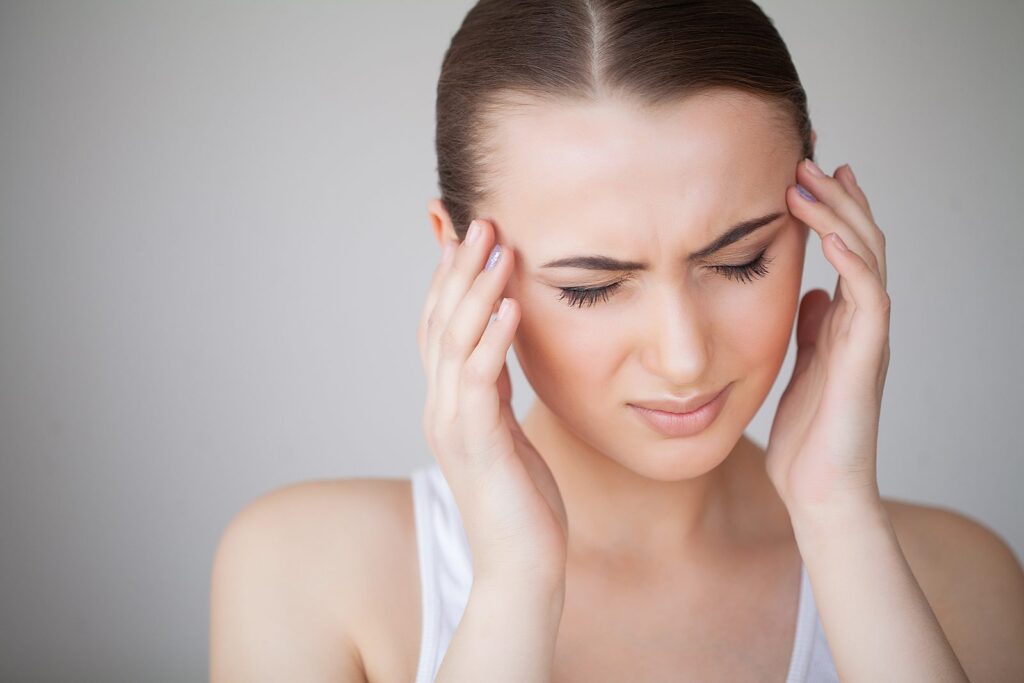
Unlike migraine and other primary headache disorders, a cervicogenic headache is considered a secondary headache, meaning the pain is caused by an underlying problem involving structures in the neck. Patients may experience head pain along with neck stiffness, reduced range of motion, or symptoms that worsen with particular neck movements or positions.
At TOPS Institute, we provide comprehensive evaluation and personalized treatment for cervicogenic headaches in Los Angeles and Beverly Hills. Our approach focuses on identifying the cervical structure contributing to the headache so treatment can be directed toward the underlying pain generato
A cervicogenic headache is referred head pain that originates from structures within the cervical spine.
Although the pain is felt in the head, the actual source may be located in the neck.
Pain-sensitive structures within the upper cervical region share neurological pathways with areas responsible for sensation in the head and face. Because of this overlap, pain originating in the cervical spine can be perceived as a headache.
Potential sources may include:
Determining which structure is responsible can be important when headaches persist despite conventional headache treatment.
Cervicogenic headaches often begin in the neck or near the base of the skull before extending toward other areas of the head.
Symptoms may include:
Symptoms vary between patients, and not every cervicogenic headache follows the same pattern.
The relationship between the headache and neck symptoms is an important part of the evaluation.
Cervicogenic headaches may develop when pain-sensitive structures within the cervical spine become irritated or dysfunctional.
Potential contributing conditions include:
The upper cervical facet joints can be particularly important because pain originating from these joints may be referred into the head.
However, identifying degeneration on an MRI or X-ray does not automatically prove that it is causing a patient’s headaches.
A diagnosis-driven evaluation is necessary to determine whether a particular cervical structure corresponds to the patient’s symptoms.
Yes. In some patients, arthritic or degenerative changes affecting the cervical facet joints can contribute to cervicogenic headache.
The facet joints are small joints located along the back of the spine. When these joints become painful, symptoms may remain localized to the neck or be referred into nearby areas.
Pain arising from the upper cervical facet joints can sometimes extend:
Cervicogenic headache and occipital neuralgia can both cause pain around the upper neck and back of the head, but they are different conditions.
Cervicogenic headache is referred pain originating from structures within the cervical spine.
Occipital neuralgia primarily involves irritation or dysfunction of one or more occipital nerves.
Occipital neuralgia often produces:
It may also cause tenderness or sensitivity along the scalp.
Cervicogenic headaches are more commonly associated with neck pain, stiffness, reduced cervical range of motion, and symptoms influenced by neck movement or position.
The conditions may sometimes overlap.
Learn more about Occipital Headaches & Occipital Neuralgia →
Migraine and cervicogenic headache can also share certain features.
Both may cause one-sided head pain and significant disruption of everyday activities.
However, migraine is a primary neurological headache disorder, whereas cervicogenic headache originates from structures within the neck.
Features suggesting a cervical contribution may include:
Some patients can have more than one headache disorder, so the presence of migraine does not necessarily exclude a cervical source of additional head pain.
Prolonged or repetitive neck positions may aggravate cervical structures and contribute to headache symptoms in some patients.
For example, extended periods of:
may increase discomfort when the cervical muscles, joints, or other structures are already sensitive.
However, posture alone should not automatically be assumed to be the cause of persistent headaches.
A comprehensive evaluation can help identify whether the cervical spine is actually contributing to symptoms.
There is no single imaging test that independently confirms every cervicogenic headache.
Diagnosis generally involves evaluating the relationship between the patient’s headache and cervical spine.
At TOPS Institute, evaluation may include a detailed review of:
A physical examination may evaluate:
Imaging such as MRI, CT, or X-rays may be appropriate when an underlying cervical condition is suspected.
However, because degenerative changes are common, imaging findings must be interpreted together with the patient’s symptoms and physical examination.
When a particular cervical structure is suspected of generating headache pain, a targeted diagnostic injection may help determine whether that structure is responsible.
For example, if an upper cervical facet joint is suspected, temporarily blocking the nerves that carry pain signals from that joint may provide valuable diagnostic information.
Meaningful temporary relief following a carefully targeted diagnostic procedure can strengthen evidence that a specific cervical structure is contributing to the headache.
This diagnosis-driven approach can also help guide subsequent treatment.
The medial branch nerves are small sensory nerves that transmit pain signals from the cervical facet joints.
When an upper cervical facet joint is suspected as the source of headache pain, a cervical medial branch block may be used diagnostically.
A small amount of local anesthetic is placed near selected medial branch nerves.
If temporarily blocking those nerves produces meaningful relief of the patient’s typical neck and headache pain, the response can provide evidence that the corresponding facet joint is contributing to symptoms.
For appropriately selected patients with confirmed cervical facet-mediated pain, radiofrequency ablation may be considered.
Cervical radiofrequency ablation (RFA) uses controlled radiofrequency energy to disrupt selected medial branch nerves that transmit pain signals from painful cervical facet joints.
By reducing transmission of these signals, RFA may provide longer-lasting relief than a temporary diagnostic nerve block.
Radiofrequency ablation is not a treatment for every headache.
It is generally considered only when evaluation and diagnostic blocks support the cervical facet joints as an important source of the patient’s pain.
Treatment depends on the cervical structure contributing to the patient’s symptoms.
Conservative treatment may include:
When symptoms persist despite appropriate conservative treatment, targeted interventional procedures may be considered based on the suspected pain generator.
Potential options may include:
An evaluation may be appropriate when headaches:
Certain headache symptoms require urgent medical evaluation.
Seek immediate medical attention for a sudden severe or “worst-ever” headache, new weakness or numbness, confusion, difficulty speaking, loss of consciousness, seizure, fever with significant neck stiffness, new vision loss, or other sudden neurological changes.
When a headache repeatedly begins in the neck, treating the head alone may not address the underlying source of pain.
At TOPS Institute, we take a diagnosis-driven approach to cervicogenic headaches.
We evaluate the relationship between headache symptoms, cervical movement, neurological findings, imaging when appropriate, and potential pain generators within the neck.
When the cervical facet joints are suspected, targeted diagnostic procedures such as cervical medial branch blocks may help confirm the source of symptoms.
For appropriately selected patients with confirmed facet-mediated pain, cervical radiofrequency ablation may provide a longer-lasting interventional treatment option.
For patients seeking cervicogenic headache treatment in Los Angeles or Beverly Hills, TOPS Institute provides personalized interventional pain management focused on identifying the source of head and neck pain and developing a targeted treatment plan.
These are the procedures our specialists most often use for failed back surgery syndrome. Your plan is confirmed after examination and imaging.
A cervicogenic headache is a secondary headache caused by pain originating from structures within the cervical spine. Although the pain is felt in the head, its underlying source is located in the neck.
Pain often begins in the upper neck or base of the skull and may travel toward the back, side, or front of the head. Some patients experience pain extending toward the temple, forehead, or area around the eye.
Features that may suggest a cervical source include headache associated with neck pain or stiffness, reduced cervical range of motion, symptoms triggered by certain neck movements, and headaches aggravated by sustained neck positions. A clinical evaluation is necessary to establish the diagnosis.
Yes. In selected patients, painful or degenerative cervical facet joints can refer pain into the head and contribute to cervicogenic headaches.
No. Cervicogenic headache originates from cervical structures, while occipital neuralgia primarily involves irritation or dysfunction of the occipital nerves. The conditions can produce overlapping symptoms and may sometimes coexist.
Cervical nerve irritation can produce neck and neurological symptoms, but cervicogenic headache is commonly associated with referred pain from upper cervical structures. A detailed evaluation can help determine whether a nerve root, facet joint, occipital nerve, muscle, or another structure is responsible.
Cervicogenic headache injections are targeted interventional procedures selected according to the suspected source of pain. They may be used diagnostically, therapeutically, or both depending on the cervical structure involved.
For selected patients whose headaches arise from painful cervical facet joints, radiofrequency ablation may be considered after diagnostic procedures support the facet joints as the pain source. RFA is not appropriate for every type of headache.
Headaches that repeatedly begin in the neck or base of the skull may require a different treatment approach than primary headache disorders.
A comprehensive evaluation can help determine whether the cervical facet joints, muscles, nerves, or another neck structure is contributing to your symptoms.
Schedule a consultation with TOPS Institute in Los Angeles or Beverly Hills for a personalized evaluation and treatment plan for cervicogenic headaches and associated neck pain.
Schedule an Appointment
Leave a message or give us a call — we'll find a time that works for you.
640 South San Vicente Blvd., Suite 389, Los Angeles, CA 90048

Interventional pain management for Los Angeles & Beverly Hills — image-guided care that treats the source, not just the symptom.
© 2026 TOPS Institute · All rights reserved · Home