
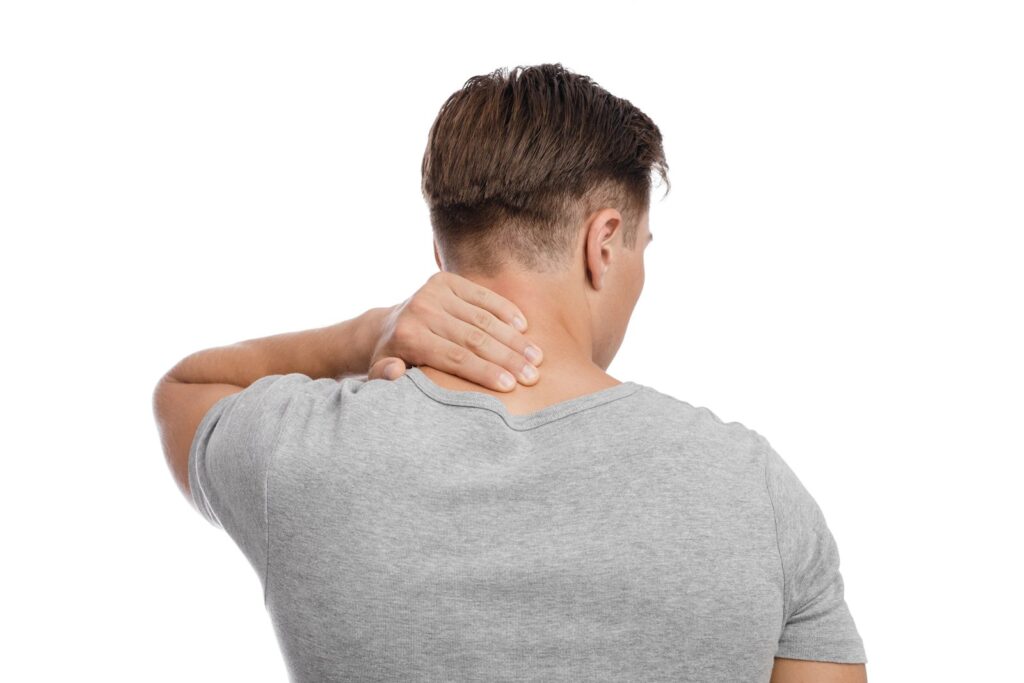
Depending on which cervical nerve is affected, symptoms may include radiating arm pain, numbness, tingling, weakness, or changes in sensation. Some patients experience significant arm symptoms with relatively little neck pain.
At TOPS Institute, we provide comprehensive evaluation and personalized treatment for cervical radiculopathy and pinched nerves in Los Angeles and Beverly Hills. Our approach focuses on identifying the source of nerve irritation and developing a targeted treatment plan designed to reduce symptoms, improve function, and help patients return to their everyday activities.
Cervical radiculopathy is a condition caused by irritation or compression of a nerve root in the cervical spine, or neck.
The cervical spine consists of seven vertebrae. Nerves exit the spinal column between these vertebrae and travel into the shoulders, arms, and hands.
Each cervical nerve root corresponds to particular areas of sensation and muscle function.
When a nerve becomes compressed or inflamed, symptoms may therefore occur away from the neck and extend into the:
“Pinched nerve” is a common, patient-friendly term frequently used to describe cervical radiculopathy, but it is not a precise medical diagnosis.
Cervical radiculopathy specifically describes symptoms caused by irritation or compression of a cervical spinal nerve root.
The nerve does not necessarily need to be physically “pinched.” Inflammation or chemical irritation surrounding a nerve root can also contribute to radicular symptoms.
Determining why the nerve is irritated is important because several cervical spine conditions can cause radiculopathy.
Cervical radiculopathy can develop whenever a condition reduces the space around a cervical nerve root or causes inflammation near the nerve.
Common causes include:
More than one degenerative condition may be present at the same time.
Identifying the underlying cause of cervical radiculopathy helps determine which treatment options may be appropriate.
Symptoms depend on the location and severity of nerve irritation.
Common cervical radiculopathy symptoms include:
Symptoms frequently affect one side of the body, although individual presentations vary.
Some patients primarily notice neck and shoulder pain, while others experience significant arm or hand symptoms.
Cervical radiculopathy often produces a distinctive radiating or nerve-like quality of pain.
Patients may describe symptoms as:
For example, irritation of different cervical nerve roots may produce symptoms in different portions of the shoulder, arm, hand, or fingers.
This pattern can help distinguish radicular pain from pain caused primarily by muscles, facet joints, or other structures in the neck.
These conditions are related but not identical.
A cervical disc herniation is a structural condition in which disc material extends beyond its normal boundary.
Cervical radiculopathy describes the neurological symptoms that develop when a cervical nerve root becomes irritated or compressed.
A herniated disc can cause cervical radiculopathy if it affects a nearby nerve, but not every cervical disc herniation causes symptoms.
Likewise, cervical radiculopathy can result from conditions other than a herniated disc, including spinal stenosis and cervical spondylosis.
Diagnosing cervical radiculopathy involves determining whether symptoms originate from a cervical nerve and identifying the condition responsible for the nerve irritation.
At TOPS Institute, evaluation may include a detailed review of:
A physical and neurological examination may evaluate:
When clinically appropriate, imaging may also be recommended.
An MRI can provide detailed information about the cervical discs, spinal nerves, spinal canal, and surrounding soft tissues. X-rays or CT imaging may also be appropriate depending on the clinical circumstances.
The goal is to determine whether the patient’s symptoms, examination findings, and imaging correspond to the same affected nerve.
Treatment depends on the underlying cause, severity of symptoms, neurological findings, functional limitations, and response to previous care.
When appropriate, conservative treatment may include:
Many cases of cervical radiculopathy may improve with nonsurgical treatment.
When persistent nerve-related pain does not respond adequately to conservative care, interventional pain management may be considered.
For appropriately selected patients, a cervical epidural steroid injection may be considered when inflammation around a cervical nerve root contributes to persistent radicular pain.
Medication is delivered into the epidural space surrounding the spinal nerves with the goal of reducing inflammation and relieving nerve-related symptoms.
Cervical epidural steroid injections may be considered for radicular symptoms associated with conditions such as:
Depending on the location of nerve involvement and individual clinical circumstances, a cervical transforaminal epidural steroid injection may also be considered.
The transforaminal approach targets medication near a specific cervical nerve root.
Because cervical spine procedures require careful consideration of anatomy, symptoms, imaging, potential benefits, and procedural risks, the appropriate injection approach should be determined individually after comprehensive evaluation.
Not necessarily.
Many patients with cervical radiculopathy can initially be treated without surgery. Depending on the underlying condition, nonsurgical care may include physical therapy, activity modification, medications, and targeted interventional procedures when appropriate.
Surgical evaluation may be necessary when significant nerve or spinal cord compression causes progressive neurological problems or when severe symptoms persist despite appropriate nonsurgical care.
The appropriate treatment depends on the patient’s diagnosis rather than the presence of a “pinched nerve” alone.
An evaluation may be appropriate when neck or arm symptoms:
Certain symptoms require prompt medical evaluation.
Seek immediate medical attention for rapidly worsening weakness, new difficulty walking or maintaining balance, significant loss of coordination or hand dexterity, or new bowel or bladder dysfunction, as these symptoms may indicate more serious neurological or spinal cord involvement.
Pain traveling from the neck into the shoulder, arm, or hand can significantly affect work, exercise, sleep, and everyday activities.
At TOPS Institute, our goal is to determine which cervical nerve is affected and why it is being irritated.
Rather than treating neck or arm pain as a diagnosis by itself, we evaluate the relationship between the patient’s symptoms, neurological findings, and imaging to identify the underlying condition.
When appropriate, targeted treatments such as cervical epidural steroid injections may be incorporated into a personalized nonsurgical treatment plan.
For patients seeking cervical radiculopathy or pinched nerve treatment in Los Angeles or Beverly Hills, TOPS Institute provides specialized interventional pain management focused on reducing symptoms, restoring function, and helping patients return to the activities that matter to them.
Cervical radiculopathy occurs when a nerve root in the neck becomes irritated or compressed. It may cause pain, numbness, tingling, or weakness extending from the neck into the shoulder, arm, hand, or fingers.
Common causes include cervical disc herniation, cervical spondylosis, cervical spinal stenosis, degenerative disc disease, and foraminal narrowing.
The location depends on which nerve root is affected. Symptoms may travel from the neck into the shoulder or shoulder blade and down different portions of the arm into the hand or fingers.
Yes. A cervical disc herniation can irritate or compress a nearby nerve root, producing pain, numbness, tingling, or weakness in the arm or hand.
No. Cervical radiculopathy describes symptoms caused by an irritated spinal nerve root. Neck arthritis, or cervical spondylosis, describes degenerative changes affecting structures of the cervical spine. Cervical spondylosis can contribute to radiculopathy if those changes narrow the space around a nerve.
Yes. Cervical spinal stenosis can reduce the space available for spinal nerves and may contribute to cervical radiculopathy. Depending on where the narrowing occurs, spinal stenosis can also affect the spinal cord, which is clinically different from isolated radiculopathy.
Yes. Many patients can initially be managed without surgery. Treatment may include physical therapy, activity modification, appropriate medications, and targeted interventional procedures when appropriate. Surgical evaluation may be necessary for certain patients with significant or progressive neurological problems.
For appropriately selected patients, a cervical epidural steroid injection may help reduce inflammation around an irritated cervical nerve root and relieve radicular symptoms. The appropriate procedure depends on the cause and location of nerve involvement as well as the patient’s individual clinical circumstances.
If neck pain is traveling into your shoulder or arm—or you are experiencing persistent numbness, tingling, or weakness—identifying whether a cervical nerve root is involved can help determine the appropriate next step.
Schedule a consultation with TOPS Institute in Los Angeles or Beverly Hills for a personalized evaluation and treatment plan for cervical radiculopathy and pinched nerve symptoms.
Schedule an Appointment
Leave a message or give us a call — we'll find a time that works for you.
640 South San Vicente Blvd., Suite 389, Los Angeles, CA 90048

Interventional pain management for Los Angeles & Beverly Hills — image-guided care that treats the source, not just the symptom.
© 2026 TOPS Institute · All rights reserved · Home