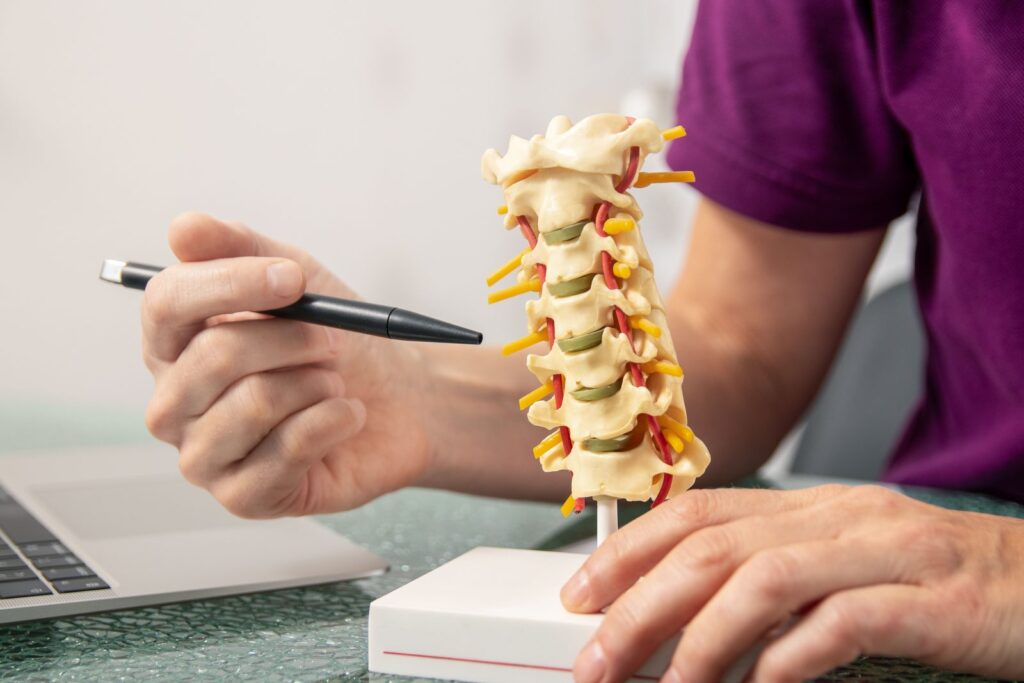
Chronic neck pain, back pain, and certain types of headaches are often caused by inflammation or arthritis of the facet joints—the small joints that connect the vertebrae of the spine. When these joints become irritated, the medial branch nerves transmit pain signals from the spine to the brain.

At TOPS Institute, our board-certified pain management specialists perform fluoroscopy-guided medial branch blocks to help diagnose and relieve pain originating from the cervical, thoracic, and lumbar facet joints. These minimally invasive procedures can help determine whether the facet joints are the source of your pain and may identify patients who are candidates for longer-lasting treatment with Radiofrequency Ablation (RFA).
A medial branch block is an image-guided injection that targets the medial branch nerves, which carry pain signals from the facet joints of the spine. By temporarily numbing these nerves with a local anesthetic, your physician can determine whether the facet joints are responsible for your symptoms.
Unlike an epidural steroid injection, which treats inflammation around spinal nerves, a medial branch block specifically evaluates pain arising from the facet joints.
The procedure may be performed for:
Medial branch blocks may be recommended for patients with:
Following a comprehensive evaluation, your physician will determine whether your symptoms are likely to originate from the facet joints.
Cervical medial branch blocks target the nerves that supply the facet joints in the neck. These joints are a common source of chronic neck pain and may also contribute to headaches that begin in the upper cervical spine.
Patients may benefit from cervical medial branch blocks if they experience:
Using fluoroscopic guidance, medication is precisely placed around the targeted medial branch nerves to maximize accuracy and safety.
Lumbar medial branch blocks are performed to evaluate pain arising from the facet joints of the lower back.
Patients may be candidates if they have:
This procedure helps determine whether the lumbar facet joints are contributing to your symptoms and whether Radiofrequency Ablation may provide longer-lasting relief.
Not all headaches originate within the brain. Cervicogenic headaches begin in the cervical spine and are commonly caused by irritation of the upper cervical facet joints, muscles, or surrounding nerves.
For carefully selected patients, cervical medial branch blocks may help identify facet joint pain as the source of these headaches.
Symptoms of cervicogenic headaches may include:
If medial branch blocks provide significant temporary relief, patients may be candidates for Radiofrequency Ablation, which can offer longer-lasting pain reduction.
Medial branch blocks are performed on an outpatient basis using fluoroscopic (X-ray) guidance.
During the procedure:
Most procedures are completed in less than 30 minutes.
Patients are often asked to monitor their pain levels over the next several hours after the procedure.
Temporary pain relief may indicate that the targeted facet joints are contributing to the symptoms.
If significant relief is achieved, your physician may recommend additional treatment, including Radiofrequency Ablation (RFA), which can provide longer-lasting pain relief by interrupting pain signals from the medial branch nerves.
Individual results vary depending on the underlying diagnosis and response to treatment.
Depending on the individual patient, medial branch blocks may:
Patients throughout Los Angeles, Beverly Hills, and Southern California trust TOPS Institute because we provide:
Our goal is to accurately identify the source of your pain and develop a treatment plan that helps restore mobility and improve your quality of life.
No. A medial branch block targets the small nerves that carry pain signals from the facet joints, while an epidural steroid injection delivers medication into the epidural space to reduce inflammation around irritated spinal nerve roots.
Most patients tolerate the procedure well. A local anesthetic is used to numb the skin before the injection, and fluoroscopic guidance helps ensure precise needle placement.
Some patients experience temporary relief lasting several hours or days, while others may notice improvement for a longer period. The primary purpose of the procedure is often diagnostic, helping determine whether the facet joints are the source of pain.
If you experience significant temporary pain relief, your physician may recommend Radiofrequency Ablation (RFA), which can provide longer-lasting pain relief by disrupting pain signals from the treated medial branch nerves.
Some patients may require additional diagnostic injections before proceeding with Radiofrequency Ablation. Your treatment plan will depend on your diagnosis, response to the procedure, and overall clinical evaluation.
If chronic neck pain, low back pain, or cervicogenic headaches are limiting your daily life, a medial branch block may help identify the source of your symptoms and guide the next step in your treatment.
At TOPS Institute, our specialists provide advanced, image-guided interventional pain management using evidence-based techniques tailored to each patient’s condition and goals.
Call 310-694-9494 or request an appointment online to schedule your consultation. We proudly serve patients throughout Los Angeles, Beverly Hills, and Southern California with personalized, minimally invasive pain management and concierge-level care.
Leave a message or give us a call — we'll find a time that works for you.
640 South San Vicente Blvd., Suite 389, Los Angeles, CA 90048

Interventional pain management for Los Angeles & Beverly Hills — image-guided care that treats the source, not just the symptom.
© 2026 TOPS Institute · All rights reserved · Home