
Pain that travels from the lower back into the buttock, leg, or foot may occur when a lumbar spinal nerve root becomes irritated or inflamed. When the affected nerve can be identified, a lumbar transforaminal epidural steroid injection (TFESI) provides a targeted way to deliver anti-inflammatory medication near that specific nerve root.
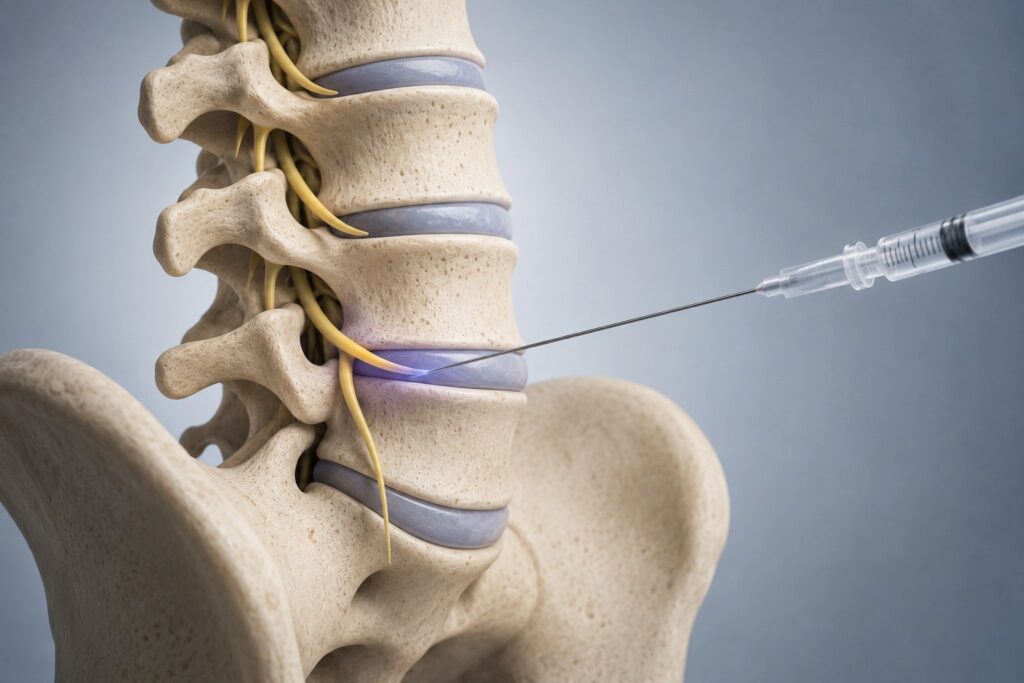
Lumbar transforaminal epidural injections are commonly considered for lumbar radiculopathy and sciatica associated with conditions such as lumbar disc herniation or foraminal stenosis.
At TOPS Institute, we provide image-guided lumbar transforaminal epidural steroid injections in Los Angeles and Beverly Hills. Our diagnosis-driven approach focuses on identifying the nerve responsible for a patient’s symptoms and determining whether a targeted epidural injection is appropriate.
Spinal nerves exit the lumbar spine through openings between adjacent vertebrae called the neural foramina.
The term transforaminal refers to the approach used to access the epidural space through this foraminal region.
By positioning medication near the affected nerve root, a TFESI can provide targeted treatment for inflammation contributing to radiating nerve pain.
The procedure does not remove a herniated disc, reverse arthritis, or permanently widen a narrowed foramen. Its purpose is to address inflammation surrounding an irritated spinal nerve.
A lumbar TFESI is primarily used for radicular pain, meaning pain associated with irritation or inflammation of a spinal nerve root.
Depending on the patient’s diagnosis, the procedure may be considered for:
Symptoms may include:
Because the procedure targets a particular nerve root, determining which nerve is responsible for the patient’s symptoms is an important part of treatment planning.
Sciatica commonly refers to pain traveling from the lower back or buttock into the leg.
A frequent underlying cause is lumbar radiculopathy, which occurs when a lumbar spinal nerve root becomes irritated or compressed.
Depending on which nerve root is affected, symptoms may travel into different areas of the:
A lumbar transforaminal epidural steroid injection may be considered when the patient’s symptoms, examination, and imaging suggest inflammation involving a particular lumbar nerve root.
A lumbar disc herniation can irritate or compress a nearby spinal nerve.
In addition to mechanical pressure, inflammation surrounding the affected nerve root can contribute to radicular pain.
A transforaminal epidural injection delivers corticosteroid medication near the affected nerve root to help reduce this inflammatory component.
The procedure does not physically remove or repair the herniated disc.
Instead, the goal is to reduce nerve inflammation, improve pain, and potentially make rehabilitation and normal activity more manageable.
Lumbar spinal stenosis is narrowing within the lower spine that can reduce the space available for spinal nerves.
For selected patients, stenosis can contribute to nerve irritation and symptoms such as:
When inflammation around an affected nerve contributes to symptoms, an epidural steroid injection may be considered as part of a nonsurgical treatment plan.
The injection does not widen the spinal canal or reverse the structural stenosis.
The injection typically contains a corticosteroid medication designed to reduce inflammation around irritated spinal nerves.
A local anesthetic may also be used depending on the procedure and clinical circumstances.
Reducing inflammation around the affected nerve may help decrease:
Pain relief can also make it easier for some patients to participate in physical therapy, exercise, and rehabilitation.
The response varies between patients, and an epidural steroid injection cannot guarantee complete or permanent pain relief.
Lumbar epidural steroid injections are typically performed as outpatient procedures.
At TOPS Institute, image guidance is used to help accurately position the needle and deliver medication to the intended area.
The procedure generally involves:
The specific technique varies depending on the patient’s anatomy, diagnosis, and location of nerve involvement.
The lumbar spine contains spinal nerves, blood vessels, bones, and other important anatomical structures.
Image guidance allows the physician to visualize spinal anatomy while positioning the needle.
Contrast material may also be used to help confirm appropriate distribution before medication is administered.
This is particularly important with a transforaminal approach because the goal is to precisely access the region surrounding a specific spinal nerve root.
Both procedures deliver medication into the lumbar epidural space, but they use different approaches.
A transforaminal epidural steroid injection approaches the epidural space through the neural foramen and delivers medication near a specific spinal nerve root.
An interlaminar epidural steroid injection enters the epidural space between adjacent vertebral structures and generally allows medication to spread within a broader portion of the epidural space.
Neither approach is automatically better.
The appropriate technique depends on:
A caudal epidural steroid injection enters the epidural space through the sacral hiatus at the base of the spine.
Medication then travels upward within the epidural space.
A transforaminal epidural injection approaches a particular nerve root through the neural foramen.
The primary difference is therefore the route and degree of targeting.
The caudal approach may distribute medication across a broader lower epidural region, while the transforaminal approach is designed to deliver medication near a selected nerve root.
A lumbar TFESI may be considered when symptoms and clinical findings suggest irritation of a specific lumbar spinal nerve.
Potential candidates may include patients who:
The duration of relief varies.
Some patients may experience meaningful improvement lasting weeks or months, while others may experience shorter or limited relief.
Results depend on factors including:
Some patients notice improvement relatively soon, while the anti-inflammatory effect of the corticosteroid may take several days to become more noticeable.
Temporary soreness or a temporary increase in symptoms may occur after treatment.
Patients should follow the post-procedure instructions provided by their physician.
The appropriate frequency varies by patient.
Factors considered may include:
Injections should not simply be repeated automatically.
At TOPS Institute, additional treatment is considered according to the patient’s clinical response and ongoing symptoms.
Lumbar TFESIs are commonly performed interventional procedures, but all medical procedures have potential risks.
Potential risks and side effects may include:
Certain medications, including blood thinners, and some medical conditions may require additional planning.
Potential risks, benefits, and alternatives should be reviewed before treatment.
Lumbar transforaminal epidural steroid injections are generally outpatient procedures.
Patients are typically monitored after the injection before returning home.
Temporary soreness around the injection area may occur.
Specific recommendations regarding activity, exercise, medications, and return to normal activities depend on the individual patient.
When symptoms improve, patients may be better able to participate in rehabilitation, exercise, and other strategies designed to support long-term function.
The benefit of a transforaminal epidural injection is its ability to target treatment near a specific spinal nerve root.
That precision makes identifying the correct nerve and understanding why it is irritated particularly important.
At TOPS Institute, we evaluate the relationship between:
before determining whether a lumbar transforaminal epidural steroid injection is appropriate.
For selected patients with lumbar radiculopathy, sciatica, lumbar disc herniation, or foraminal stenosis, a TFESI may help reduce nerve inflammation and improve function without surgery.
For patients seeking lumbar transforaminal epidural steroid injections in Los Angeles or Beverly Hills, TOPS Institute provides personalized interventional pain management focused on accurate diagnosis and targeted treatment.
A lumbar transforaminal epidural steroid injection is a minimally invasive procedure that delivers anti-inflammatory medication into the epidural space near a specific lumbar spinal nerve root through the neural foramen.
Transforaminal refers to the approach through or near the neural foramen, the opening through which a spinal nerve exits the spine. This approach allows medication to be delivered near a selected nerve root.
It may help selected patients when sciatica is associated with inflammation of a specific lumbar spinal nerve root. A comprehensive evaluation helps determine whether the patient’s symptoms are appropriate for this treatment.
A TFESI does not repair or remove the herniated disc itself. It may reduce inflammation around a nerve root irritated by the herniation and help relieve associated radicular pain.
A lumbar epidural steroid injection is a broad category of procedures that deliver medication into the epidural space. A transforaminal epidural is a specific approach designed to deliver medication near an individual spinal nerve root through the neural foramen.
A transforaminal injection targets a specific spinal nerve through the foraminal region. A caudal epidural enters through the sacral hiatus at the base of the spine and allows medication to spread upward through the epidural space.
The duration varies between patients. Some experience improvement for weeks or months, while others experience shorter or limited relief.
No. A lumbar TFESI is a minimally invasive injection procedure and does not involve a surgical incision or removal of spinal tissue.
A transforaminal epidural injection cannot guarantee that surgery will be avoided. For appropriately selected patients, however, reducing nerve inflammation may improve symptoms sufficiently to continue nonsurgical treatment and rehabilitation. Whether surgery is necessary depends on the underlying condition, neurological findings, and response to treatment.
When lower back pain travels into a particular area of the leg or foot, identifying the affected spinal nerve can help guide more targeted treatment.
Schedule a consultation with TOPS Institute in Los Angeles or Beverly Hills to determine whether a lumbar transforaminal epidural steroid injection may be appropriate for your sciatica or lumbar nerve pain.
Schedule an Appointment
Leave a message or give us a call — we'll find a time that works for you.
640 South San Vicente Blvd., Suite 389, Los Angeles, CA 90048

Interventional pain management for Los Angeles & Beverly Hills — image-guided care that treats the source, not just the symptom.
© 2026 TOPS Institute · All rights reserved · Home